On Windows 10 these extensions do show up in Settings, Apps - but the Uninstall button is often greyed out. On Windows 11 they can vanish entirely. Here is how to actually remove HEVC and HEIF, and put them back - even now that the Store blocks the reinstall on Windows 10.
These are Microsoft Store media extensions, not desktop programs. They register a codec with Windows, and the way they show up depends on which version of Windows you are on.
On Windows 10 they appear in Settings, Apps, Apps & features - but the Uninstall button is frequently greyed out. On Windows 11 they may not appear at all. Either way, one PowerShell line removes them cleanly.
Try the graphical route first: Settings, Apps, search "HEVC" or "HEIF", and click Uninstall if it is available. If it is greyed out or missing, open PowerShell as administrator (not Command Prompt) and run Get-AppxPackage *HEVCVideoExtension* | Remove-AppxPackage. Swap HEVC for HEIF to remove the image one. To reinstall, Windows 11 users can use the Store; Windows 10 users should grab build 2.4.95.0 from our HEVC Video Extensions from Device Manufacturer page, because every current build no longer installs on Windows 10.
First, look in Settings - especially on Windows 10
Do this before touching any command. On Windows 10, open Settings, Apps, Apps & features (searching "Add or remove programs" in Start opens the same page) and type "HEVC" or "HEIF" in the search box.
If you see the extension listed with an active Uninstall button, just click it - you are done. Some extensions, such as the AV1 Video Extension, remove this way in seconds.
The catch: for HEVC and HEIF the Uninstall button is often greyed out, even though the extension is clearly listed. That is not a bug on your end - Windows simply will not let the graphical tool remove certain built-in components. When that happens, PowerShell is the way through.
On Windows 11 the list moved to Settings, Apps, Installed apps, and these extensions are often hidden from it entirely. If you cannot find them there, skip straight to the PowerShell steps below.
Use PowerShell, not Command Prompt
This trips up almost everyone, so it is worth a moment. The commands below are PowerShell commands. They do not work in the black Command Prompt (cmd) window.
If you paste them into Command Prompt, you get this:
'Get-AppxPackage' is not recognized as an internal or external command,operable program or batch file.That message means you are in the wrong window - not that the command is wrong. Open the right one:
- Windows 10: click Start, type PowerShell, right-click Windows PowerShell and choose Run as administrator.
- Windows 11: right-click Start and choose Terminal (Admin) - it opens PowerShell by default.
See what you actually have installed
From that elevated PowerShell window, run this first. It lists which extensions are present and their exact names, so the removal command cannot miss.
Get-AppxPackage | Where-Object {$_.Name -like "*HEVC*" -or $_.Name -like "*HEIF*"} | Select Name, PackageFullName 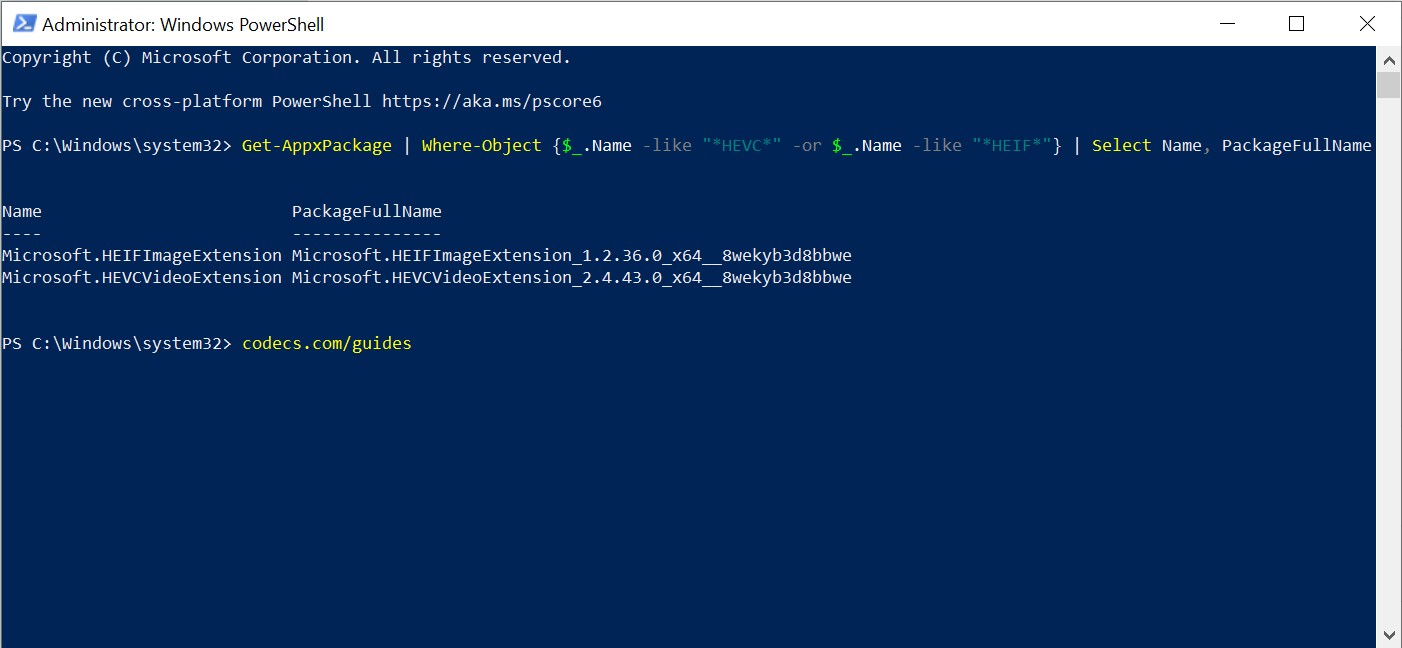
Anything listed is installed. Nothing listed means it is already gone, and whatever problem sent you here has another cause.
Remove them
One command each, run from the same elevated PowerShell window.
HEVC Video Extensions:
Get-AppxPackage *HEVCVideoExtension* | Remove-AppxPackageHEIF Image Extensions:
Get-AppxPackage *HEIFImageExtension* | Remove-AppxPackageBoth print nothing when they succeed. Re-run the check command from the previous section to confirm - an empty result means it worked.
Why PowerShell rather than winget? winget reaches Store apps only through its msstore source, and these extensions are frequently absent from its index. That produces "No package found matching input criteria" even though the extension is plainly installed - a known winget limitation, not a mistake on your part. Remove-AppxPackage talks to Windows' own package system and has no such gap.
If it will not go, or keeps coming back
Three situations account for nearly all of these.
- Other accounts still have it. Removing a package only removes it for you. To clear it from every account on the PC, add
-AllUsersto the Get-AppxPackage call. - It reappears for new users, or after a feature update. The package is provisioned - staged into the Windows image so every new profile gets it. Removing the installed copy does not touch the provisioned one. See the command below.
- "HEVC Video Extensions from Device Manufacturer" refuses to uninstall. Same cause. The OEM edition ships provisioned in the factory image, so it re-installs itself as fast as you remove it.
To remove the provisioned copy as well, run this from the same elevated PowerShell window:
Get-AppxProvisionedPackage -Online | Where-Object {$_.DisplayName -like "*HEVC*"} | Remove-AppxProvisionedPackage -OnlineThis one affects the whole machine. Deprovisioning removes the extension from the Windows image, so new user accounts will no longer receive it and it will not return after updates. That is usually the point - but it is a system-wide change, not a per-user one. Run it only if the extension genuinely keeps coming back, and remember you may need to reinstall manually on any new account afterwards.
Put them back
Reinstalling is where Windows 10 and Windows 11 part ways, so check which one you are on.
On Windows 11, Microsoft publishes a free HEVC listing. One version costs $0.99; the other - HEVC Video Extensions from Device Manufacturer - is free, because device makers already paid the H.265 licence fee. Same files, same publisher. It is simply not searchable in the Store, so open it directly. Press Win + R, paste the line below into the Run box (not a terminal), and press Enter:
ms-windows-store://pdp/?ProductId=9n4wgh0z6vhqWindows 10: the reinstall now fails. The entire HEVC extension 2.5.x series requires Windows 11. On Windows 10 every 2.5 build stops with the same error, whether it comes from the Store or you install the package by hand:
Windows cannot install package Microsoft.HEVCVideoExtension_2.5.x ...because this package is not compatible with the device. The packagerequires a newer OS version ... The device is currently runningOS version 10.0.19045.x. (0x80073CFD)This hits the paid listing, the free Device Manufacturer listing, and even the older 2.5.10 package - all of them are now built for Windows 11 only. It is not a fault on your PC.
The fix for Windows 10 is the last build that still supports it: version 2.4.95.0. Our HEVC Video Extensions from Device Manufacturer page keeps the older builds - pick 2.4.95.0, not a 2.5 version - and it installs on Windows 10 in under two minutes, free and with no Microsoft account.
To re-register it from files already on your disk instead, see installing HEVC Video Extensions when the Store or winget fails, or how to get the HEVC Video Extension for free to obtain the package directly.
HEIF Image Extensions still installs normally on both Windows 10 and Windows 11 - from the Store, or from our HEIF Image Extensions page.
Removing it to fix playback? There may be no need. A reinstall rarely fixes HEVC video that will not play - the usual culprits are graphics drivers or the file itself → Check HEVC support for your GPU
HEVC video that will not play works through the causes worth checking before you remove anything.
If you would rather use winget
It works on some machines for removal, and it is quicker to type. Just do not spend time on it if it fails once - the failure is structural, not intermittent. Run it in PowerShell or Command Prompt, both are fine for winget:
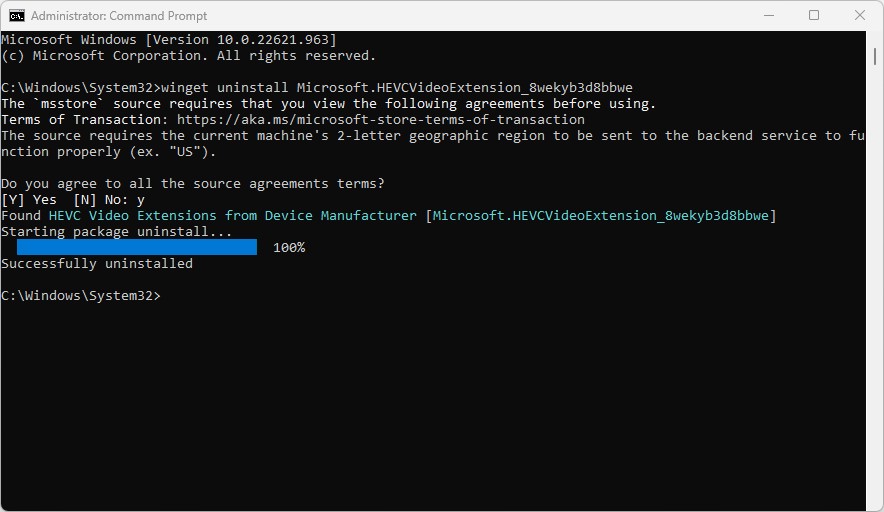
winget uninstall Microsoft.HEVCVideoExtension_8wekyb3d8bbwe Note the full package family name rather than a short ID. Plain --id=Microsoft.HEVCVideoExtension is the form most often reported as failing, because winget resolves Store IDs through an index these extensions are frequently missing from. Adding --force makes no difference when the package cannot be resolved in the first place - the command has nothing to force.
And on Windows 10, winget cannot install the current HEVC extension either - it is the same Windows 11-only package, so it fails for the same reason. Use the download page above instead.
Quick questions
The extension is listed in Settings but Uninstall is greyed out. Now what?
That is normal for HEVC and HEIF - Windows blocks the graphical uninstall for certain built-in components. Open PowerShell as administrator and run Get-AppxPackage *HEVCVideoExtension* | Remove-AppxPackage (or *HEIFImageExtension*). That removes it regardless of the greyed button.
Why do I get "'Get-AppxPackage' is not recognized"?
Because you are in Command Prompt (cmd), not PowerShell. Get-AppxPackage is a PowerShell command. Close that window, open Windows PowerShell (Admin) on Windows 10 or Terminal (Admin) on Windows 11, and run it there.
Why won't HEVC reinstall on Windows 10?
Every 2.5.x build now requires Windows 11 build 26200, so they fail on Windows 10 with error 0x80073cfd - even the older 2.5.10. Install the last Windows 10-compatible build, 2.4.95.0, from our HEVC Video Extensions from Device Manufacturer page instead.
I removed it but it came back. Why?
The package is provisioned into the Windows image, so it reinstalls for new profiles and after some updates. Remove the provisioned copy as well with the Remove-AppxProvisionedPackage command above.
Will removing HEVC break anything?
Only HEVC playback in apps that rely on the Windows decoder - Movies & TV, Photos, Explorer thumbnails. Players that carry their own decoder, such as VLC, are unaffected. Nothing else on the system depends on it.
Do I need to restart afterwards?
Not for the removal itself, but apps already running keep the old decoder list until they restart. If a video still behaves as though the extension is present, close the player and reopen it.


@Tanaka
To check if HEIF Image Extensions and HEVC Video Extensions are installed and find their versions on your Windows system, follow these steps:
Open Settings (press Win + I).
Go to Apps > Installed apps.
In the search bar, type HEIF or HEVC to locate the installed extensions.
Click the extension and select Advanced Options (if available).
The version number will be listed under Specifications.