Your HEVC video opens to a black screen, an error message, or nothing at all - and the file is right there, refusing to play. The problem is almost never the video itself.
Windows simply doesn't include an H.265 decoder out of the box, and this guide fixes that in about two minutes, then covers every other cause if the quick fix isn't enough.
Install the free HEVC Video Extensions from Device Manufacturer to make HEVC work system-wide in Windows, or open the file in VLC Media Player, which decodes H.265 on its own. One of these two solves roughly 90% of "HEVC won't play" cases.
First, find out what's actually broken
Before installing anything, spend 30 seconds narrowing down the cause. It saves you from fixing the wrong thing.
Drag your file into our free online HEVC player - it runs in your browser and needs no install. If the video plays there, the file is fine and your system is just missing a decoder. If it fails there too, the file itself may be damaged or use an unusual profile.
Fix 1: Install HEVC codec support in Windows
Windows 10 and Windows 11 ship without an HEVC decoder because of patent licensing fees. That's why Photos, the Movies & TV app, and Windows Media Player all fail on H.265 files even on a brand-new PC.
Microsoft sells its HEVC Video Extensions in the Store for $0.99, but there's a fully official free version - the "from Device Manufacturer" edition that Microsoft published for OEM devices. Microsoft delisted it from the Store in 2023, but the signed installer still works on Windows 10 and 11.
Our guide on how to download the HEVC Video Extension for free walks you through it step by step.
Once installed, HEVC works everywhere in Windows - built-in apps, video editors, even File Explorer thumbnails. This is the cleanest fix if you want the system, not just one player, to understand H.265.
Fix 2: Use a player that decodes HEVC by itself
If you'd rather not touch system codecs, use a player with its own built-in decoder. VLC Media Player plays HEVC natively on Windows, Mac, Linux, and Android - no extensions, no codec packs.
PotPlayer and MPC-HC are excellent alternatives with the same self-contained approach. The trade-off: other apps on your PC still won't recognize HEVC, so thumbnails and editing software stay broken until you also apply Fix 1.
Fix 3: Black screen with sound? Check 10-bit and your GPU
Audio playing over a black or green screen is the classic symptom of a hardware decoding mismatch, not a missing codec. A lot of modern HEVC - especially 4K and HDR - is encoded in 10-bit (Main 10 profile), which needs newer hardware to decode on the GPU.
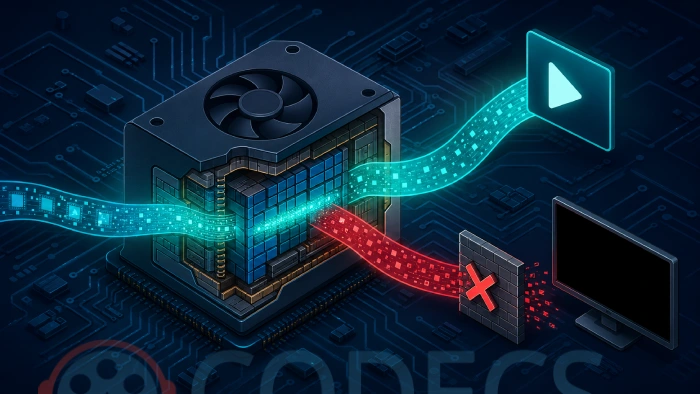
As a rule of thumb: 8-bit HEVC hardware decoding arrived with Intel 6th-gen (Skylake) CPUs and NVIDIA GTX 950/960 cards, while 10-bit needs roughly Intel 7th-gen (Kaby Lake) or NVIDIA GTX 10-series and newer.
Fix 4: Toggle hardware acceleration
When the GPU picks the wrong decoding path, flipping hardware acceleration usually fixes it instantly. In VLC, go to Tools > Preferences > Input / Codecs and switch "Hardware-accelerated decoding" from Automatic to Disable - or from Disable to DirectX (DXVA 2.0) if it was already off.
Disabling acceleration forces your CPU to do the work. That fixes black screens on older GPUs, though a weak CPU may stutter on 4K files. Enabling it does the opposite - smooth 4K playback on modern hardware that was struggling in software mode.
Fix 5: Update your graphics drivers
Outdated GPU drivers are behind a surprising share of HEVC failures - crashes, artifacts, and stuttering included.
Download the latest driver directly from NVIDIA, AMD, or Intel rather than relying on Windows Update, which often serves older versions.
This matters most after a fresh Windows install or a major update, when the generic driver Windows picks may not expose HEVC decoding at all.
Fix 6: No sound instead of no video? That's AC-3, not HEVC
Since Windows 11 version 24H2, Microsoft no longer bundles the AC-3 (Dolby Digital) audio decoder. So if your HEVC video shows a perfect picture but plays silently in Windows apps, the video codec is fine - the audio codec is missing.
The simplest cure for this and every other codec gap is the K-Lite Codec Pack, which installs decoders for HEVC, AC-3, and practically everything else system-wide in one setup. If you regularly download videos from mixed sources, it's the set-and-forget option.
Fix 7: Convert the file as a last resort
If a file needs to play on an old TV, an ancient laptop, or a device you can't install anything on, convert it to H.264. Load it into HandBrake, pick the "Fast 1080p30" preset, and you'll get an MP4 that plays on virtually anything made in the last 15 years.
Expect the converted file to be noticeably larger - H.265 exists precisely because it squeezes the same quality into roughly half the size of H.264. Convert only when the fixes above aren't an option.
Mac, iPhone, and Android
Mac: macOS has supported HEVC natively since High Sierra (2017), so playback failures usually mean a very old macOS or a damaged file. QuickTime and the free IINA player handle H.265 well on any recent Mac.
iPhone and iPad: HEVC is native since the iPhone 7 - it's what your camera records in. If a downloaded file won't play, the container (often MKV) is the problem, not the codec; VLC for iOS opens it.
Android: Most devices from the last several years decode HEVC in hardware. When the stock player refuses a file, VLC for Android or MX Player almost always plays it.
Still stuck?
Run through this order: test the file in the online HEVC player, install the free HEVC extension, try VLC, toggle hardware acceleration, update drivers. If the file fails everywhere including other devices, it's corrupted - re-download it from the source.
The two-minute version: grab the free HEVC Video Extensions from Device Manufacturer for system-wide support, and keep VLC installed as your plays-anything backup. Between them, HEVC stops being a problem.


Latest comments
AllInteresting development with the Fire TV Stick 4K — losing Kodi sideloading is a big deal for a lot of users. For those ...
News: The New Fire TV Stick 4K Can't Run Kodi - Here's Which Fire Stick Still Can 3 commentsThanks genius, it worked for me. v2.4.149.0 on windows 10
Guide: How to Download HEVC Video Extension for Free 181 commentsXMediaRecode gives only the option to Copy (No convert) in Audio Mode drop down. I am trying to convert/recode the EAc3 ...
Team replied Guide: How to Convert EAC3 Audio to AC3 or AAC With XMedia Recode 1 comment