Your file has an EAC3 soundtrack and something in the chain will not play it - a TV, an older phone, a car stereo, a program that just gives you silence. Converting the audio track fixes it for good.
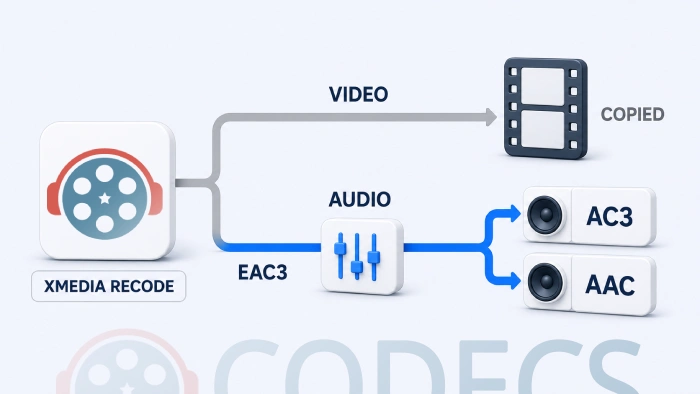
EAC3, also written E-AC-3 and sold as Dolby Digital Plus, is the audio on most streaming rips and a great many Blu-ray remuxes.
It sounds excellent, and it is not supported everywhere.
The reason is licensing rather than difficulty.
Dolby charges for the decoder, so budget devices and some free apps leave it out and hand you a silent video or a blunt "EAC3 Audio Not Supported" message.
This guide converts that track to AC3 or AAC using XMedia Recode, which is free, and leaves the video completely untouched so the job takes minutes rather than hours.
Nothing is wrong with your file. The EAC3 track is fine, and the device trying to play it simply has no decoder for it.
If you want the background on the format itself, our explainer on what EAC3 actually is covers how it compares with AC3 and AAC.
First, check you actually need to convert
Converting re-encodes audio that has already been compressed once, so a little quality goes every time. If you can solve the problem by changing player instead, do that.
- Watching on a computer, phone or tablet? Install a player that already decodes EAC3 - our roundup of players that decode EAC3 out of the box covers the good ones.
- On Android specifically? VLC for Android handles it with nothing to configure, and PotPlayer does the same on Windows.
- Attached to MX Player? The MX Player Custom Codec restores EAC3 without touching your files - see EAC3 audio not supported in MX Player for the version matching.
Convert when you cannot install anything on the device that has to play the file. Smart TVs, USB playback, car head units, games consoles, older tablets and anything you are sending to someone else all fall into that group.
AC3 or AAC? Decide before you start
This is the only real decision in the process, and it depends entirely on what has to play the file.
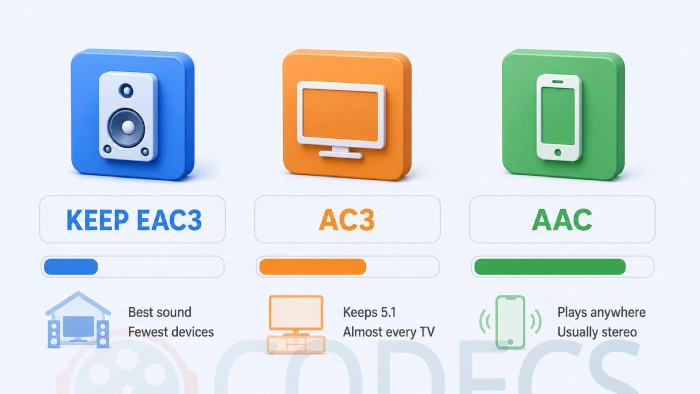
| Convert to | Best for | Surround | Use this when |
|---|---|---|---|
| AC3 (Dolby Digital) | TVs, soundbars, AV receivers, USB sticks, car stereos | Keeps 5.1 | You care about surround and the file plays on a TV or a hi-fi |
| AAC | Phones, tablets, browsers, older iOS devices | Usually stereo | You want the widest possible compatibility and are watching on a small screen |
| Both, as two tracks | Anything, including the original setup | Keeps 5.1 plus a stereo fallback | The file is a keeper and you do not mind a slightly larger one |
AC3 is the safe default for anything that reaches a television. It has been in every set-top box and receiver for two decades, and it carries 5.1 without argument.
AAC wins on phones and browsers, but it will usually downmix your surround track to stereo, which is a real loss on a film. If that trade matters to you, our comparison of DTS, AC3 and AAC goes into where each one is genuinely better.
Step 1: Load the file into XMedia Recode
Download XMedia Recode free and install it. It is Windows only, and there is nothing bundled with it.
Open the program and click Open File, then pick the video with the EAC3 track. XMedia Recode reads the streams and lists every audio track it finds.
Step 2: Choose the output container
Go to the Format tab, leave Profile on Custom and pick your container under Format. This is the wrapper, not the audio format, and the two choices behave differently.
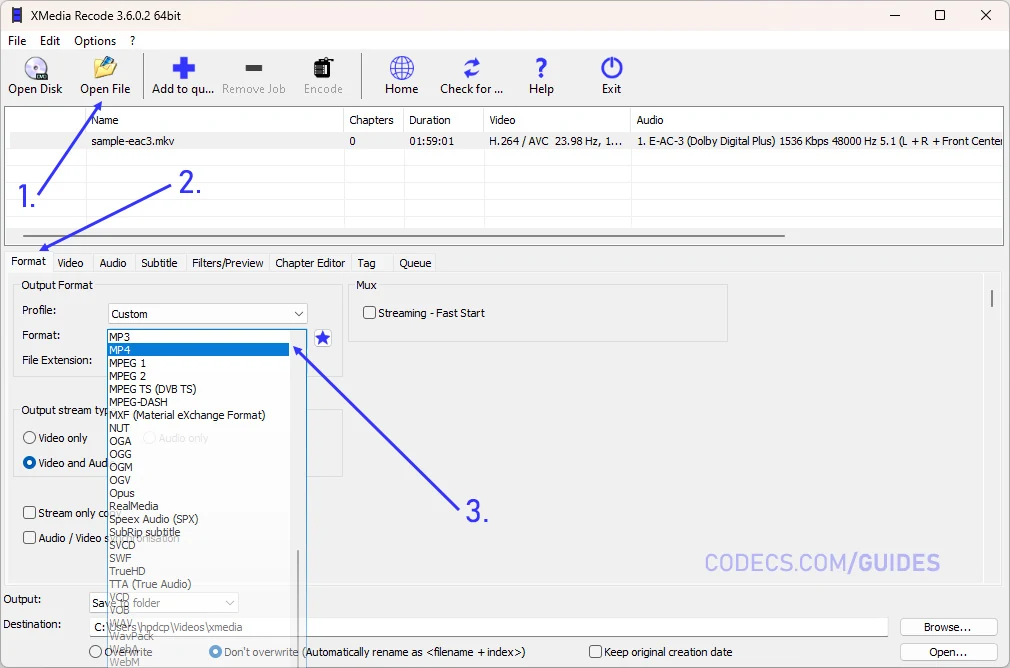
- MKV holds as many audio tracks as you like, so pick it if you want to keep the original EAC3 alongside the new track.
- MP4 is the safer bet for TVs, phones and anything reading from a USB stick, because some devices will not open MKV at all.
If your target device is fussy enough to lack an EAC3 decoder, it is often fussy about containers too. MP4 is the more conservative answer.
Step 3: Set the video to Copy
This is the step the job actually turns on, and it is the one most people miss.
Open the Video tab and set Mode to Copy. That tells XMedia Recode to pass the picture through untouched and re-encode only the audio.
Leave it on Convert and the program re-encodes your entire video as well. A two-hour film goes from a couple of minutes of work to several hours, and the picture comes out measurably worse for no benefit at all.
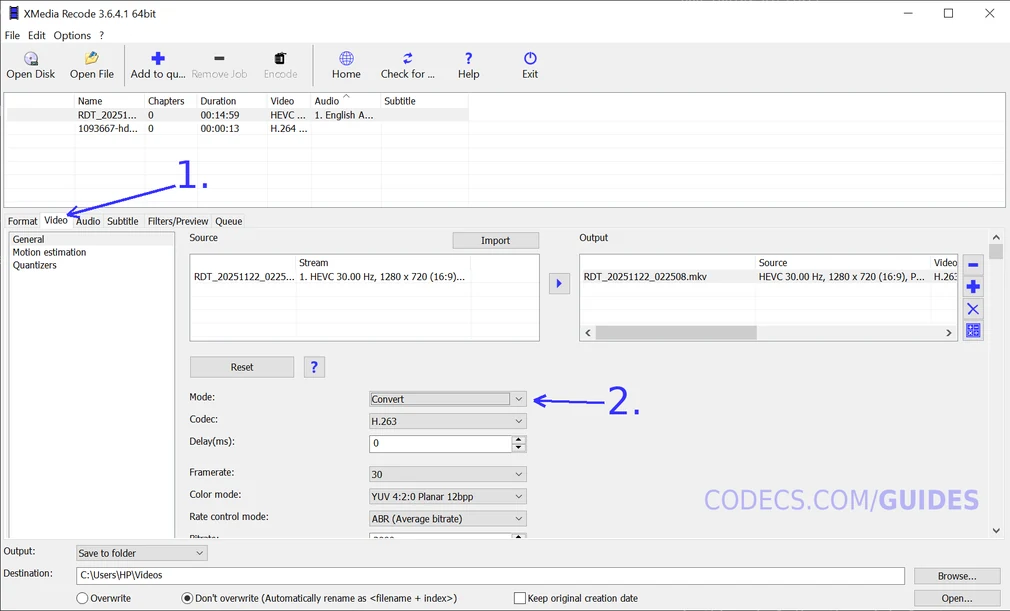
Copying the video and re-encoding one audio track is a partial remux, and it is why this job is so quick. Our guide on the difference between transcoding and remuxing explains why one costs hours and the other does not.
Step 4: Convert the audio track
Open the Audio tab. It has two lists: Source on the left is what the file contains, Output on the right is what the new file will get. The settings underneath belong to the track selected in Output.
- Check the Output list. The EAC3 track is usually there already. If it is empty, click the track under Source, then the arrow button between the two lists (Add audio stream).
- Click the track in Output. Until a track is selected there, Mode is greyed out.
- Set Mode to Convert. Then pick AC3 or AAC under Codec.
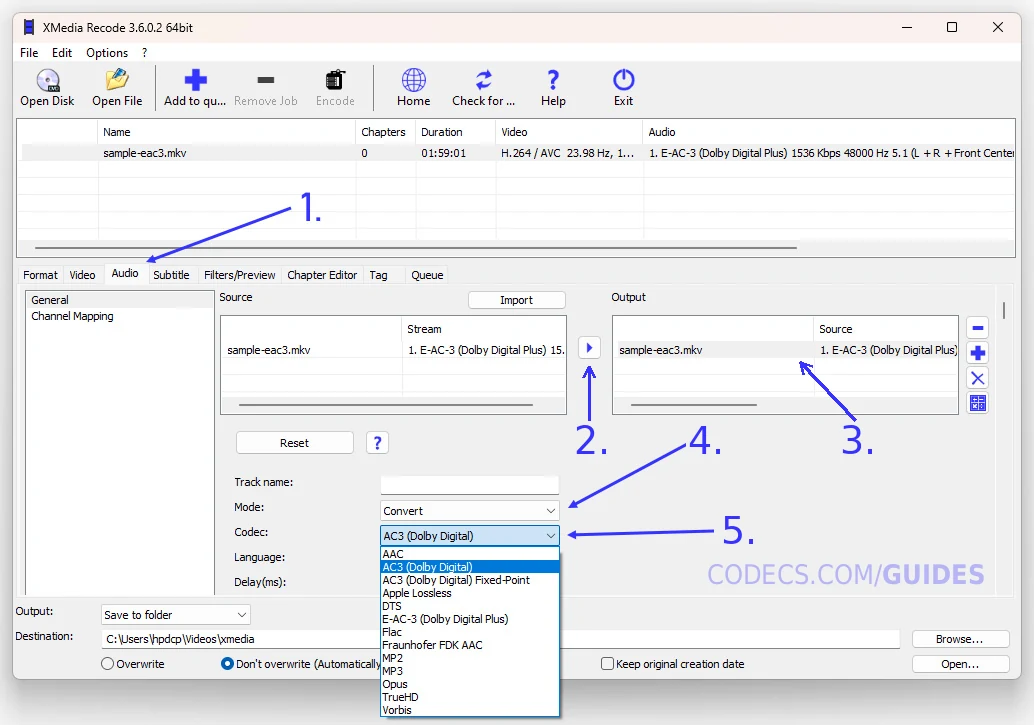
Three settings sit underneath the codec and are worth a moment.
- Bitrate. For AC3 in 5.1 use 448 kbps, the broadcast standard, and for AAC in stereo 192 to 256 kbps is plenty.
- Channels. Leave it at the source layout to keep 5.1, or set it to 2.0 if the target is a phone, a laptop or a single speaker.
- Sample rate. Leave this alone - the source is almost always 48 kHz and changing it gains you nothing.
Want to keep the original as well? Click the arrow a second time so Output holds two copies of the track, set the first to Copy and the second to Convert, and the output carries both. Use MKV for this.
Step 5: Add to queue and encode
Click Add to Queue, then Encode. XMedia Recode writes a new file and leaves your original exactly where it was.

With the video set to Copy this finishes fast, often quicker than the film is long. If it is grinding away for hours, go back and check Step 3.
If it still does not play
A converted file that behaves no better usually has one of five things wrong with it.
- Mode only offers Copy. No track is selected in the Output list, or a Format preset is locking the audio. Set Profile to Custom on the Format tab, then go back to Step 4.
- Silent output. The new track was probably added without the old one being deselected, so the device is still landing on EAC3 - remove or reorder the tracks so your new one is first.
- The file is enormous. The video got re-encoded, which means Step 3 did not take.
- The TV still refuses it. The container may be the problem rather than the audio, so try MP4 instead of MKV.
- Audio drifts out of sync. Rare with Copy on the video, and usually a variable frame rate in the source - check what the file actually contains before re-running it.
Not sure what you are starting with? The online codec finder tells you what is inside a file without installing anything.
Other tools that do this job
XMedia Recode is the friendliest option on Windows, but it is not the only one.
- MKVToolNix swaps and reorders tracks inside MKV files without re-encoding anything, which is ideal when you already have an AC3 track to add.
- eac3to is the specialist for Dolby formats, handling EAC3, TrueHD and DTS-HD from the command line.
- HandBrake and FFmpeg both do the same job, the first with presets and the second with total control.
- For a bare audio file rather than a video, the online audio converter handles it in your browser.
Quick questions
Will converting EAC3 lose audio quality?
A little, yes. You are re-compressing something already compressed, so keep the bitrate generous and only convert when you cannot install a player instead.
AC3 or AAC - which should I pick?
AC3 if a TV, soundbar or receiver has to play it, because it keeps 5.1. AAC if it is a phone, tablet or browser.
Will I lose surround sound?
Not with AC3, which carries 5.1 comfortably. AAC usually downmixes to stereo unless you set the channel layout yourself.
Why does the audio Mode only show Copy?
Mode belongs to the track in the Output list on the right. Click the track there, or add it from Source with the arrow button first, and Convert appears.
Why is my conversion taking hours?
The Video tab is still set to Convert, so the whole picture is being re-encoded. Set it to Copy and the job drops to minutes.
Can I keep the original EAC3 track as well?
Yes. Use MKV as the container, add the track to Output twice, and set one to Copy and the other to Convert.
Is XMedia Recode free?
Yes, it is freeware for Windows, with no paid tier and nothing bundled into the installer.
Set the video to Copy, convert only the audio track, and pick AC3 for a television or AAC for a phone. Done that way the file plays everywhere and the picture is untouched.
The rest of the audio codecs section covers the formats around it, and Windows Sonic, Dolby Atmos and DTS explains what your system is doing with them.
Download XMedia Recode and see how it handles your files, or tell us how you got on if you have already tried it.


Thanks for this - you found a gap in the guide. On the Audio tab the settings belong to the track in the Output list on the right, not the Source list. When you removed the track there, Mode had nothing to apply to.
Click the EAC3 stream under Source, click the arrow button between the two lists (Add audio stream), then click the new track in Output - Mode will offer Convert. Step 4 is now updated with a screenshot showing exactly this.