A system image is a photograph of your entire Windows installation - the operating system, your programs, your settings and your files, in one restorable file.
If the drive dies or Windows stops booting, you put the image back and the machine is exactly as it was.
Windows still includes the tool to make one, and it takes about five clicks.
This page covers both halves - making the image, and the restore that most guides never get round to explaining.
What You Will Need
- An external drive with room to spare. The image holds everything currently on your system drive, so check how full that drive is and allow comfortably more.
- A separate USB flash drive for the recovery drive, which is what actually starts the restore.
- Administrator access, and thirty to sixty minutes depending on how much you are imaging.
Making the Image, Step by Step
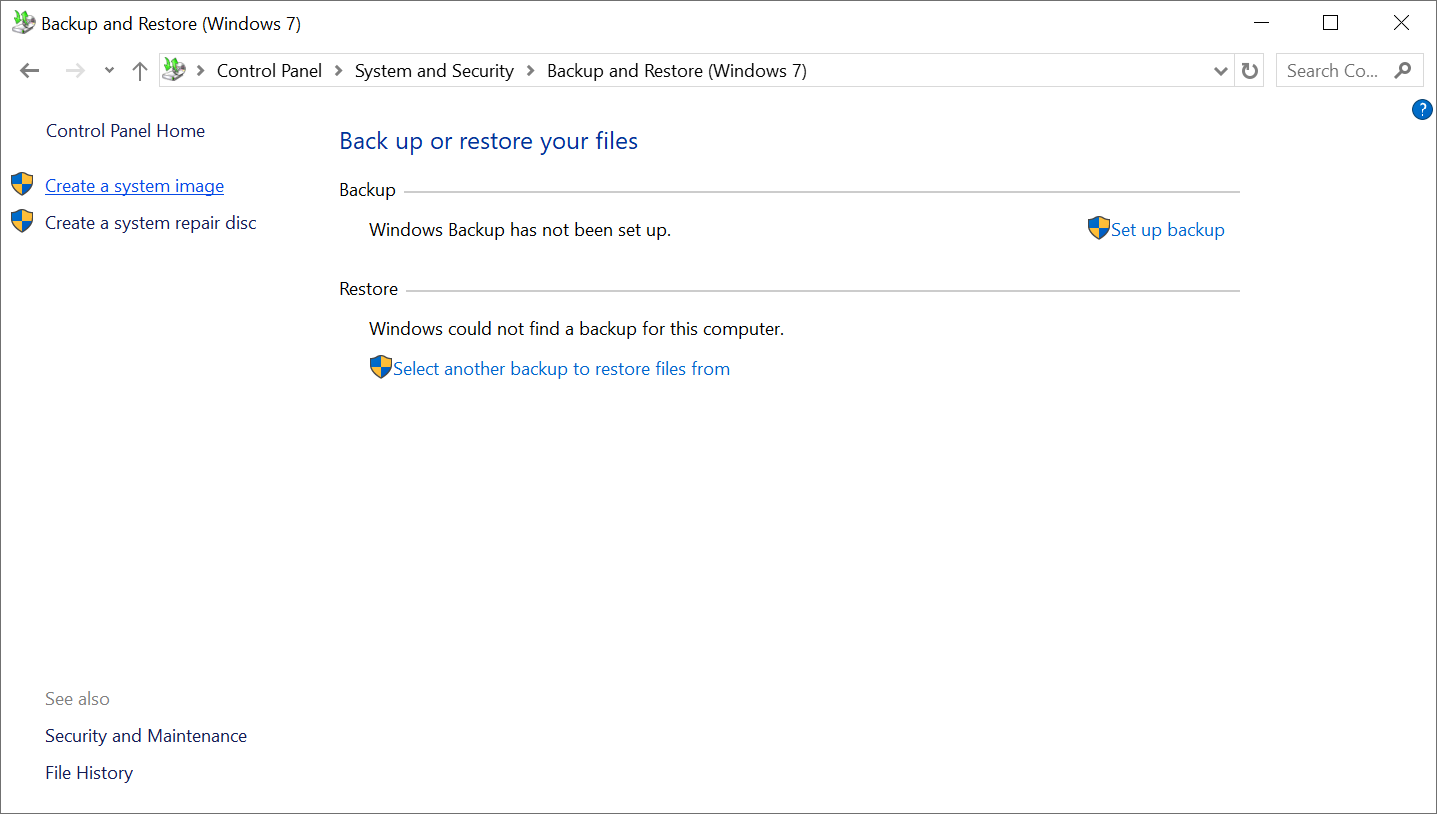
- Open Control Panel and go to System and Security, then Backup and Restore (Windows 7). The name is a leftover; the tool is still there in Windows 11.
- Click Create a system image in the left sidebar and wait while Windows scans for somewhere to put it.
- Choose your external drive as the destination. Leave it plugged in and do not rename it halfway through.
- Check the summary. Windows picks the drives your system needs to run and tells you how much space the image will take.
- Click Start backup. You can carry on using the PC while it runs, though everything will feel slower.
Do not tidy up the folder afterwards. Windows saves the image as a folder called WindowsImageBackup in the root of the drive, and recovery finds it by looking for that exact name in that exact place - move it into a subfolder and your backup becomes invisible to the only tool that can read it.
Make the Recovery Drive Too
The image on its own cannot save you. Something has to boot the PC before it can be restored, and a dead Windows will not do it.
Search the Start menu for Recovery Drive and follow it through onto a spare USB stick. It takes a few minutes and you only do it once.
Our full walkthrough of creating a bootable USB recovery drive covers the options if you want the detail.
How to Actually Restore It
This is the part you will want on a bad day, so it is worth reading once on a good one.
If Windows still starts. Hold Shift and click Restart from the Start menu, then choose Troubleshoot, then Advanced options, then System Image Recovery.
If it does not. Boot from the recovery drive, pick your keyboard layout, and take the same route - Troubleshoot, then Advanced options, then System Image Recovery.
On some manufacturers' machines it hides one level down. If System Image Recovery is not in the Advanced options list, look for See more recovery options and it will be in there.
Windows scans the attached drives, finds the most recent image and offers it. Accept it, or pick an older one if you know the newest is after the problem started.
The restore wipes the target drive. It replaces everything on it with the contents of the image, so anything created since that image was made is gone - and if the process is interrupted the machine may not boot at all, so do not do it on a failing battery.
What This Tool Cannot Do
It is worth knowing the edges before you rely on it, because Microsoft has not touched this tool in years and will not be fixing what goes wrong.
It is all or nothing. A system image restores the whole drive. Pulling one file out of it is not something the interface offers.
Network destinations are where it fails. Saving to a NAS or a network share is the most common source of errors with this tool, and they are awkward to diagnose. Use a directly attached drive.
Optical discs are not worth attempting. Imaging to DVDs has well-known failure modes where it asks endlessly for another disc or simply never finishes.
It expects the same machine. An image restored onto genuinely different hardware often will not boot, so treat it as insurance for this PC rather than a way of moving to a new one.
If you want an imager that is still actively developed, Clonezilla does the same job from a bootable USB stick and is free.
How Often to Make a New One
Before anything risky is the real answer - a feature update, a new drive, a driver you are unsure about, or any upgrade that involves working around hardware requirements.
Flyoobe is the common case there, since it bypasses the TPM and CPU checks to get Windows 11 onto older machines. Image the machine first and a failed attempt costs an afternoon rather than everything.
Beyond that, monthly is plenty for most people. Leave room on the destination drive for more than one image so a bad one does not become your only one.
Label the drive with the date. You can also create a custom drive icon so the backup drive is recognisable at a glance in File Explorer, which matters more than it sounds when there are three identical black boxes in a drawer.
One Thing an Image Is Not
A system image protects the machine. It is not a file backup, and it is a poor fit for the things you change every day.
Nobody images a PC hourly, so the documents you edited this morning are not in last month's image. That is a different job with different tools.
Our guide to backing up Windows for free covers that side, and the two together are what a real backup looks like.
Quick questions
Does this still work in Windows 11?
Yes. The tool is called Backup and Restore (Windows 7) and it lives in Control Panel rather than Settings, which is why people assume it is gone. Microsoft deprecated it years ago and stopped developing it, but it still runs.
How big does the backup drive need to be?
Bigger than the amount of space currently used on your system drive, with room left over. Allow for more than one image if you can, so a bad backup does not replace a good one.
Can I get a single file out of a system image?
Not through the interface, which restores the whole drive or nothing. If you need individual files back, that is what a file backup is for.
Why can recovery not find my backup?
Almost always because the WindowsImageBackup folder was moved or renamed. It has to sit in the root of the drive under that exact name, so put it back and the restore will see it again.
Can I restore the image onto a different computer?
Usually not successfully. The image carries drivers and settings for the machine it came from, so a different one often will not boot. Treat it as insurance for this PC.
Do I still need the recovery drive if I have the image?
Yes, and it is the half people skip. The image is the contents; the recovery drive is what starts the computer so the contents can be put back.
Five clicks today, and the worst a dead drive costs you is an afternoon.
Everything else for the job sits on our HDD, SSD and USB tools page.
Try Clonezilla if you would rather use something still being maintained, or leave a comment telling us whether a restore ever saved you.


Latest comments
AllHola cuando descargo un video con mpc-hc lo descarga en formato webm en vez de mp4 o mp3
Team replied Guide: How to Stream Videos with MPC-HC 1 commentInteresting development with the Fire TV Stick 4K — losing Kodi sideloading is a big deal for a lot of users. For those ...
News: The New Fire TV Stick 4K Can't Run Kodi - Here's Which Fire Stick Still Can 3 commentsThanks genius, it worked for me. v2.4.149.0 on windows 10
Guide: How to Download HEVC Video Extension for Free 181 comments