On 1 October 1982, Sony put the first CD player on sale in Japan, and music went digital.
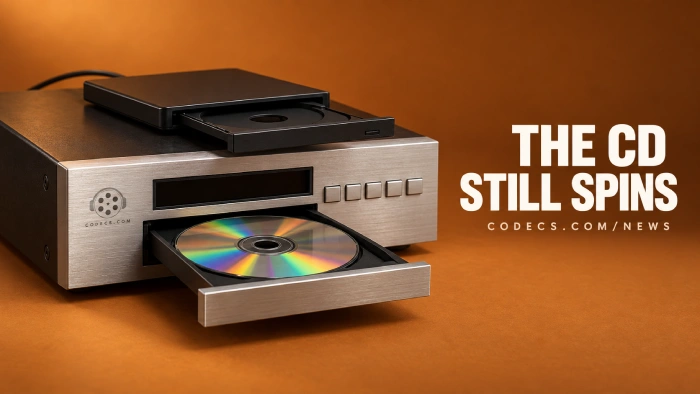
The Sony CDP-101 cost 168,000 yen - about $3,700 in today's money, as Tom's Hardware points out.
Forty-four years later, CDs are selling again, while most new laptops can't read one.
Here is how a 1982 music player led to MP3, to the LAME encoder, and to the free tools that still rescue your discs.
What went on sale that day
The CDP-101 launched in Japan only, with around 50 albums from CBS to play on it. Billy Joel's 52nd Street is usually named as the first album ever sold on CD.
Philips, which created the format with Sony, brought its own CD100 player to the West six months later, with just 16 titles. Early adopters paid a lot for very little to listen to.
There is a nice detail in that first Sony, too: it used one converter for both stereo channels, so the left and right channels sat about 11 microseconds apart. Nobody could hear it, but it remains a favourite piece of audio trivia.
Ten years later, the CD met the PC
CD-ROM drives only became common in home computers in the early to mid 1990s, at the start of the multimedia PC era. That timing turned out to matter for music.
CD audio is 16-bit, 44.1 kHz stereo, which works out to about 1,411 kbps - roughly 10 MB for every minute. That was far too big for a 1990s hard drive, let alone a modem download.
MP3 arrived just in time. The audio standard was finished in 1992, the .mp3 name was chosen in 1995, and Winamp made it popular in 1997 - the story of how MP3 was built covers the details.
Where LAME comes in
Every PC now had a CD drive and a way to shrink music, so people began ripping their CDs. In 1998 a small open-source project called LAME started improving the MP3 encoder, and it became the MP3 encoder most free rippers still use.
LAME MP3 Encoder was quiet for years, then version 4.0 arrived in July 2026. A bigger 4.1 update is in the works, with faster encoding and a long-standing quality fix.
Your CDs are still worth ripping
A disc in a drawer is one scratch away from silence, and the drive to read it gets harder to find every year. Ripping it once keeps the music playable on any phone, PC or car stereo.
- Get a drive. If your laptop has no disc slot, a cheap external USB drive works without installing anything.
- Use fre:ac. fre:ac is free, reads the disc, looks up the track names and uses LAME to make MP3s.
- Choose FLAC or MP3. FLAC keeps a perfect copy of the CD; MP3 at 320 kbps is under a quarter of the size and sounds the same to most ears.
Our CD ripping guide walks through the whole process. If you go with MP3, the best LAME settings guide tells you which quality option to pick.
Quick questions
When did the first CD player go on sale?
On 1 October 1982 in Japan. The Sony CDP-101 cost 168,000 yen, about $3,700 in today's money.
What was the first album released on CD?
Billy Joel's 52nd Street is the album usually named as first. It went on sale in Japan alongside the CDP-101.
Can I still play and rip CDs on a modern PC?
Yes. Plug in an external USB disc drive and Windows or macOS will see it without extra drivers. Free software such as fre:ac then copies the music to your PC.
Should I rip to FLAC or MP3?
FLAC if you want an exact copy to keep for good, MP3 if you want small files for a phone or car. Many people rip to FLAC once and convert to MP3 from that.
The bottom line
The CD outlived the $3,700 player that launched it, and the MP3 and LAME tools it inspired are still free. Dig out your old discs and rip them while you still have a drive. Tell us which CD you bought first.


Latest news comments
AllThe Vega OS shift is the biggest Firestick story of 2026. Anyone buying now needs to know: 4K Max = sideloading works, plain 4K = ...
News: The New Fire TV Stick 4K Can't Run Kodi - Here's Which Fire Stick Still Can 2 commentsBrave just enabled it by default for stable users yesterday (1.97). Not specified is chromeOS will be passively gaining decode capability too, and ...
News: JPEG XL Is Back in Chrome: What It Means and How to Open JXL Files 1 commentI didn't know it was EU, AND france. That doesn't sound like a good idea. Related to coding or privacy.
News: Meet Qwant: The Private, EU-Built Alternative to Google 1 comment