An M3U file holds no video and no music. It is a plain-text list of links - which is why a 12,000-channel playlist can be smaller than a single photo.

Open one in Notepad and you can read the entire thing. That is the whole secret, and it is the part nobody explains.
Everything below follows from it: why your playlist opens instantly but plays nothing, why channel names sometimes turn into gibberish, and why the same file works in VLC, on your TV box, and in a browser.
An M3U file is a playlist - a text file listing addresses of things to play. M3U8 is the same file saved in UTF-8 text encoding. For opening a file, treat them as identical. Any player that takes one takes the other.
What is actually inside an M3U file
There are two flavors, and you have almost certainly met both.
The plain kind is as simple as it looks. One address per line, nothing else:
Music/track01.mp3Music/track02.mp3http://stream.example.com/radioThat is a complete, valid M3U file. This is the original 1990s Winamp format, and it is still what your music player exports when you save a playlist.
The extended kind is what IPTV uses. It adds an information line above each address:
#EXTM3U#EXTINF:-1 tvg-id="BBCNews.uk" tvg-logo="https://example.com/logo.png" group-title="News",BBC Newshttps://example.com/live/bbcnews/index.m3u8Four things to notice, and then you can read any playlist on the internet:
-
#EXTM3Uis the header. It appears once, at the very top, and means "this playlist has extra information in it". If it is missing, some players will treat the file as the plain kind and ignore all your channel names. -
#EXTINF:-1is the info line. The number is the duration in seconds - and -1 means "live, no fixed length", which is why every IPTV channel uses it. A music playlist would say#EXTINF:243instead. -
tvg-id,tvg-logoandgroup-titleare optional tags your player reads to match the program guide, show the channel logo, and sort channels into folders. Delete them and the channel still plays - it just looks bare. - The text after the comma is the channel name you see on screen. The next line is the actual stream address.
That is the entire format. No compression, no encryption, no magic - which is exactly why it won.
What the "8" in M3U8 actually means
This is where nearly every explanation on the web stops halfway. There are two answers, and both are true at the same time.
1. The original meaning: text encoding
M3U8 means an M3U file saved as UTF-8 text. The 8 is literally the 8 from UTF-8.
The old M3U format used whatever text encoding your computer happened to use locally. Fine for English. A disaster for everything else - Arabic, Cyrillic, Chinese and accented European names all came out scrambled on someone else's machine.
UTF-8 handles every alphabet on earth, so M3U8 became the sane default. If channel names in your list show up as é or Ñ or a row of question marks, that is this problem, and saving the file as UTF-8 fixes it.
2. The modern meaning: HLS streams
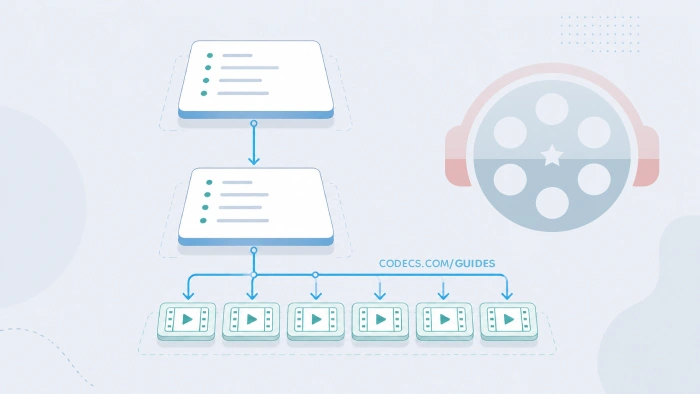
The .m3u8 extension is also the manifest format for HLS - HTTP Live Streaming, the delivery method behind most live video on the internet today.
An HLS manifest is still just a text playlist. But instead of listing channels, it lists video chunks - a few seconds of footage each - plus the available quality levels.
Your player reads it, grabs the chunks in order, and switches quality as your connection changes.
So both are happening at once. An IPTV playlist is often an .m3u8 file containing channels, where each channel points at another .m3u8 file containing video chunks. Same extension, two completely different jobs, one nested inside the other.
The practical takeaway: for opening a file, M3U and M3U8 are interchangeable. Nobody needs to sell you a converter between those two - renaming the file changes nothing that matters.
Converting to a different playlist format is a separate question, and that one is real. More on it further down.
Where M3U files come from
The format is older than IPTV by about a decade, which is why "m3u file" means different things to different people:
- IPTV playlists - the big one today. A list of live TV channels, usually delivered as a URL rather than a file.
- Music playlists - saved from Winamp, foobar2000, VLC or a ripped CD. Often full of relative paths like
Music/track01.mp3, which is why they break the moment you move the folder. - Internet radio - a handful of station URLs in a text file.
- Anything that exports a playlist - the format is so simple that plenty of tools use it as a lowest-common-denominator export.
How to open an M3U file
First, just read it. Open the file in a text editor - Notepad on Windows, TextEdit on Mac, anything at all. If your system refuses, make a copy and rename it to .txt.
Thirty seconds of reading tells you what a player never will: whether the file has real addresses in it, roughly how many, and whether it is a live IPTV list or an old music playlist pointing at folders that no longer exist.
On Windows, Mac or Linux, VLC Media Player is the answer, and it is free with no ads. For a downloaded file: Media, then Open File. For a link: Media, then Open Network Stream, paste the URL, press Play. Open View, then Playlist to see the channels.
Windows opening your playlist in the wrong app? It sometimes hands .m3u files to Media Player or Groove Music, which choke on live stream URLs. Right-click the file, choose Open with, then Choose another app, pick VLC, and tick Always use this app. That one setting solves a surprising share of "my M3U will not open" complaints.
In a browser, with nothing installed, paste the URL or drop the file into our free Web Player and the channel list appears on the left. Nothing is uploaded anywhere - the file is read on your own device. It is the quickest way to check a playlist on a work laptop, a Chromebook, or any machine where installing software is not an option.
On a TV, phone or streaming box, the app depends on the device, and the differences are real - remote support, program guide, ads. Our guide to the best free IPTV players for M3U playlists has the right pick for each screen, plus the steps to load your list in it.
When the app refuses the file, it wants a different playlist format
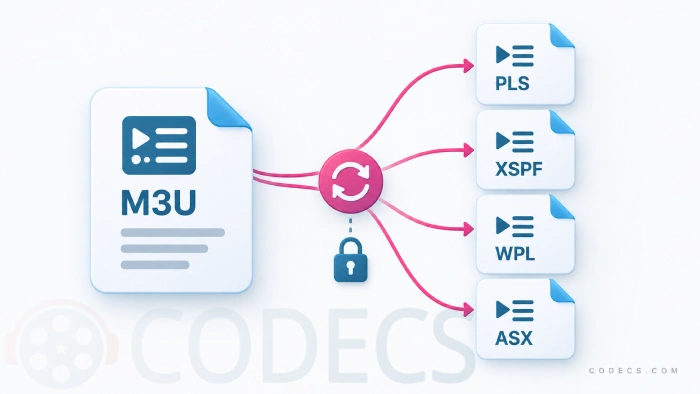
M3U is the most common playlist format, not the only one. A handful of apps never learned to read it, and they will not tell you that - they just refuse the file.
Windows Media Player wants WPL. Older Winamp setups, a lot of car stereos and plenty of DLNA media servers want PLS. Some servers and Linux players prefer XSPF, and a few Windows Media tools still expect ASX.
None of these is better than M3U. They are the same idea - a list of addresses - written with different punctuation.
This is the one conversion that is actually real. The free X M3U Converter turns M3U or M3U8 into PLS, XSPF, WPL, ASX or a plain text list, and back again. It runs in your browser with no signup, and the playlist never leaves your computer.
It carries the IPTV tags across too. group-title, tvg-logo and tvg-id survive the trip, so your channel logos and groups do not vanish on the way out.
It also fixes the broken music playlist. The path options let you strip every entry down to its filename, or find and replace an old folder path with the new one.
That is the two-click cure for a playlist that stopped working the day you moved your music - the problem this guide warned you about a few paragraphs ago.
For bigger jobs there is a Windows app as well. It merges several playlists into one, strips duplicates, and repoints missing entries at whichever folder your files moved to.
Your M3U opens but nothing plays. Now what?

Almost every M3U complaint is one of these six, and only one of them is actually the file's fault:
| What you see | What is really going on |
|---|---|
| Nothing plays at all | The file is fine; the source is dead. Public streams go offline constantly. Try a different list before you blame the app. |
| Some channels work, some do not | Completely normal for any large free list. A healthy list has a handful of dead entries. If half of it fails, the source itself is stale. |
| Channel names look like gibberish | Encoding, as above. Save the file as UTF-8. |
| It opens in Notepad instead of playing | File association, not corruption. Set VLC as the default app for .m3u files. |
| A player or TV app rejects the file outright | Some apps only read PLS, WPL or XSPF. The format is the problem, not the playlist - convert it with the tool above. |
| Picture but no sound, or the reverse | A codec gap on your device, not a playlist problem. The Codec Finder will tell you exactly what is missing. |
Test the list before you load it. Run any playlist through our free M3U Checker - it tests each stream, marks it Online, Reachable, Timeout or Offline, and lets you export only the ones that answered. It takes a minute and saves an evening.
Can I write my own M3U file?
Yes, in Notepad, in about a minute:
- Start with the header. Type
#EXTM3Uon the first line, on its own. - Add a channel. Write
#EXTINF:-1,Channel Name, then put the stream address on the line below it. Repeat for each channel. - Save it as playlist.m3u. Choose UTF-8 encoding if your editor offers it, so accented names stay readable.
- Double-click it. Your default player opens the list. Done.
That is genuinely all there is to it. No tool required, no special software, no format to learn beyond what you read above.
Is an M3U file legal?
The format itself is as neutral as a .txt file - it is a list of addresses and nothing more. What matters is what the addresses point at.
The line to watch. Playlists of free-to-air channels - the news, public TV, music and weather channels that broadcasters put online for free themselves - are entirely legal to use. Playlists of paid sports or pay-TV channels that someone is redistributing without permission are not, whatever the site offering them claims.
If you want lists that stay on the right side of that line, our guide to free popular IPTV playlists covers the sources worth trusting and how to spot a dead one.
Quick questions
Is M3U8 better than M3U?
For non-English channel names, yes - UTF-8 encoding keeps them readable. Otherwise there is no difference in quality or capability. It is a text encoding, not a format upgrade.
Do I need to convert M3U to M3U8?
No. Any player that opens one opens the other. If names look scrambled, re-save the file as UTF-8 in a text editor - that is the only conversion between those two that ever helps.
A different playlist format is a different question, and the section above covers it.
How do I convert an M3U playlist to PLS, WPL or XSPF?
Drop the file into the free X M3U Converter, pick the output format, and download the result.
It runs in your browser, so nothing is uploaded and it works the same on Windows, Mac, Linux or a Chromebook. It reads PLS, XSPF, WPL, ASX and plain text going the other way too.
Why is my M3U file only 2 KB?
Because it holds no video. A 2 KB playlist pointing at hundreds of hours of live TV is working exactly as designed.
Can an M3U file contain a virus?
Not on its own - it is plain text, and text does not execute. The risk is never the file, it is what you install to open it. Stick to known players and you have nothing to worry about.
My music M3U stopped working after I moved the folder. Why?
It is full of relative paths like Music/track01.mp3, which only work from the original location. Open it in a text editor and you will see the broken paths immediately.
Fixing them by hand is fine for ten tracks and miserable for five hundred. The converter above has find-and-replace and filename-only path options that rewrite the whole list in one pass.
The bottom line
An M3U file is a text file full of links, and everything confusing about it comes from people expecting it to be more than that. It cannot be corrupted in any interesting way, it cannot carry a virus, and it never needs converting to M3U8 - only to a different playlist format, and only when an app insists.
Open it in Notepad, and if the links inside are alive, any player on any device will play them.


Latest reviews
AllFree M3U Playlist for TiviMate: Legal Lists That Load Cleanl...
5/5The link isn't working. https://www.free-codecs.com/guides/free-epg-urls-for-iptv.htm
The New Fire TV Stick 4K Can't Run Kodi - Here's Which Fire ...
5/5The Vega OS shift is the biggest Firestick story of 2026. Anyone buying now needs to know: 4K Max = sideloading ...
JPEG XL Is Back in Chrome: What It Means and How to Open JXL...
5/5Brave just enabled it by default for stable users yesterday (1.97). Not specified is chromeOS will be passively gaining decode ...