In 2021 MX Player bet on a video codec almost nobody wanted - and a 2026 patent fight made that bet look smart.
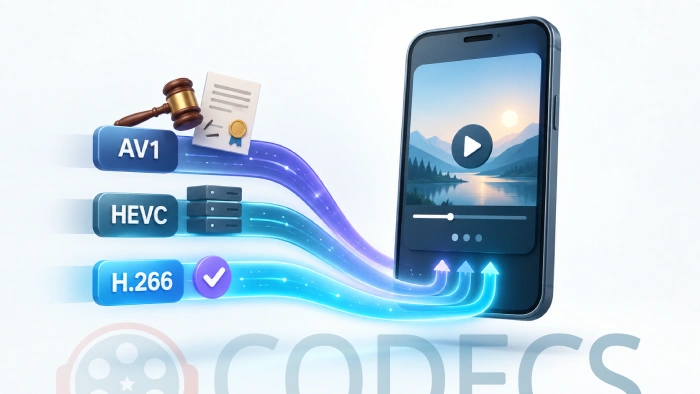
The codec was H.266, also called VVC, and the industry had nearly written it off.
Then Dolby sued Snapchat over AV1, the "royalty-free" codec that was supposed to win.
Here is how the story went, what changed since spring, and what any of it means for the videos on your phone.
Updated 17 September 2026.
Amazon retired the MX Player brand in July, Dolby widened its case against Snap in June, and a new AV1 patent pool is being formed. All three are covered below.
The Bet That Made No Sense (2021)
In June 2021, MX Player called itself the first streaming service in the world to use H.266. It was an odd move - almost no phones had H.266 chips, and nobody knew what the licence would cost.
MX Player said the new codec cut data use by more than half. For viewers in India on daily data caps, that meant more episodes on the same plan.
The less-told part: MX Player had already rolled out AV1 too. It was not picking a side. It was betting on both.
The Obituary (December 2025)
By late 2025, H.266 looked finished. Analyst Alex Davies of Rethink Research called it "essentially dead on arrival", arguing that faster networks and good software decoders left no room for it.
AV1 was winning instead. Netflix said AV1 now carried about 30% of its streaming, and Snapchat had built AV1 into its own video pipeline.
Dolby Sues Snap (March 2026)
On 23 March 2026, Dolby sued Snap in a Delaware federal court and in Rio de Janeiro. The patents cover both AV1 and HEVC, and many of them came from General Electric, whose video patents Dolby bought in 2024.
Access Advance, the patent pool Dolby belongs to, called it the first AV1 lawsuit against a streaming platform by one of its licensors. Dolby's point was simple: calling a codec "royalty-free" does not cancel patents held by companies that never made that promise.
We covered the filing in detail in our full story of Dolby's lawsuit against Snap.
What Happened Next (June - September 2026)
- June 8: Dolby filed an amended complaint in Delaware adding five more patents, and a third complaint in Brazil.
- July 16: Amazon retired the Amazon MX Player brand and moved its shows into Prime Video.
- August 25: Access Advance started forming a new AV1 and AV2 patent pool for device and software makers.
That last one matters most. A patent pool for AV1 is an open admission that AV1 is not free for everyone - only the patents of Alliance for Open Media members come with a royalty-free promise.
As of mid-September, no ruling or settlement in the Snap case has been made public.
The New Math
Two years ago the choice looked easy: AV1 was free, HEVC was messy, and H.266 was dead. Here is how it looks now.
| Codec | Licensing in 2026 | Where you will meet it |
|---|---|---|
| AV1 | Sold as royalty-free, now at the centre of lawsuits and a new patent pool | Netflix, YouTube, most modern phones and browsers |
| HEVC (H.265) | Mature, but split across several pools and also named in the Snap case | iPhone videos, 4K TVs, Blu-ray rips |
| H.266 (VVC) | Paid, but mostly through one pool with over 6,200 patents | Rare - some Intel Lunar Lake laptops, MediaTek Pentonic TVs, Android 17 phones with the right chip |
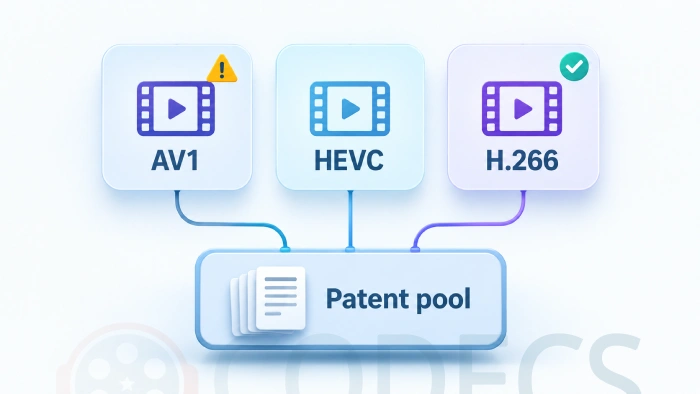
Access Advance's Video Distribution Pool already licenses VP9, AV1, HEVC and VVC in one deal, and it expects to add AV2 in 2027. So "switch codecs" is not really an escape route for Snap - the same pool covers most of the options.
H.266 has also crept onto phones. Android 17 added H.266 playback, although it only works on phones whose chip can decode it.
Why MX Player Looked Smart - and the Twist
Amazon bought MX Player in 2024 for under $100 million. With that deal came rare, real-world experience of streaming H.266 to millions of phones, at a time when that suddenly looked less silly.
The twist came in July. Amazon dropped the MX Player name for streaming and folded the shows into Prime Video, and it has said nothing public about whether Prime Video uses H.266 anywhere.
So the bet looked smart just as the brand behind it disappeared. Whether the know-how lives on inside Prime Video is the open question.
What This Means for Your Phone
Nothing breaks today. Patent fights are between companies, and your videos keep playing while the lawyers argue.
The MX Player app on Android still works as a local file player after the rebrand. It is free and ad-supported.
If films play with picture but no sound, that is Dolby again - EAC3 and AC3 are Dolby audio formats, and MX Player does not include them. Install the free MX Player Custom Codec, then pick it under Settings, Decoder, Custom codec.
If AV1 videos stutter or will not open, here is how to get AV1 working on Android.
Quick questions
Is AV1 still free to use?
For viewers, yes - you never pay to watch AV1. For companies, the royalty-free promise only covers patents from Alliance for Open Media members, which is why Dolby could sue and why a new AV1 patent pool is being formed.
Is MX Player shutting down?
The streaming brand is gone - Amazon folded it into Prime Video on 16 July 2026. The Android app remains, and it still plays video files stored on your phone.
Can my phone play H.266 videos?
Only if it runs Android 17 and has a chip with an H.266 decoder. Android does not include a software decoder for it, so most phones still cannot play it.
Will Snapchat stop working because of the lawsuit?
There is no sign of that. Cases like this usually end in a licence deal, and no court order against Snapchat has been made public.
Why does MX Player play video with no sound?
The file most likely uses EAC3, AC3 or DTS audio, which MX Player does not include. The free MX Player Custom Codec adds them.
The codec war is not over, but your videos do not have to wait for the verdict.
Get MX Player 3.2.1 for Android and see how it handles your files, or tell us which codec you are betting on.
Source: Access Advance announcement of the AV1/AV2 patent pool.


Latest news comments
AllInteresting development with the Fire TV Stick 4K — losing Kodi sideloading is a big deal for a lot of users. For those ...
News: The New Fire TV Stick 4K Can't Run Kodi - Here's Which Fire Stick Still Can 3 commentsBrave just enabled it by default for stable users yesterday (1.97). Not specified is chromeOS will be passively gaining decode capability too, and ...
Team replied News: JPEG XL Is Back in Chrome: What It Means and How to Open JXL Files 1 commentI didn't know it was EU, AND france. That doesn't sound like a good idea. Related to coding or privacy.
News: Meet Qwant: The Private, EU-Built Alternative to Google 1 comment