H.264 is the oldest of the modern video codecs and the least efficient - yet it is the one format that plays on practically every device on earth. It won the format war without ever being the best. Here is why.
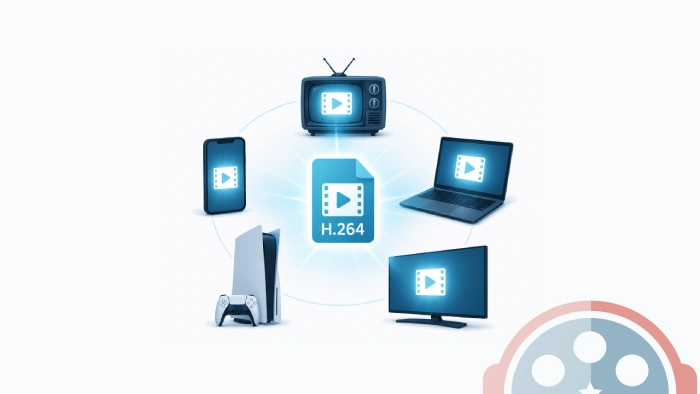
H.264 plays everywhere because it arrived first, got built directly into the hardware of billions of devices, and had licensing terms tame enough for everyone to adopt without fear.
None of that has anything to do with it being the "best" codec. It is simply the one the whole world already agreed on.
It showed up at exactly the right moment
H.264 (also called AVC, or Advanced Video Coding) was finalized in 2003. That timing was perfect.
Broadband was just getting fast enough for online video. Smartphones were about to explode. HD was becoming the new normal.
H.264 hit the sweet spot of decent quality at a reasonable file size right as all of that took off. So it became the default for the first big wave of digital video: YouTube, the iPhone, Blu-ray, broadcast TV, even security cameras.
Once something becomes the default, it tends to stay the default. And two powerful forces locked H.264 in.
Reason 1: the hardware was built for it
Decoding video using a general-purpose processor is expensive - it burns battery and generates heat. To avoid that, chipmakers add a dedicated "decoder block" to the silicon, tuned for specific codecs.
Because H.264 was the universal format, essentially every phone chip, graphics card, smart TV, and laptop made in the last 15 years shipped with a hardware H.264 decoder built in.
That hardware does not go away. Those billions of devices are still in use, and they still play H.264 instantly with almost no battery cost.
A 2015 TV cannot learn AV1 later. But it already knows H.264 - permanently.
Reason 2: the licensing was tolerable
H.264 does carry patent royalties, but the terms were relatively clear and capped. Crucially, there were no royalties charged for free internet video shown to viewers.
That meant companies could adopt H.264 without legal anxiety, so almost all of them did.
This is exactly what did not happen with its successor, HEVC (H.265). HEVC's tangled, multi-group royalty situation scared off adopters and slowed it down - which is a big reason newer royalty-free codecs like AV1 got their opening.
So "plays everywhere" really means...
It got established first, the entire device ecosystem hardwired support for it, and nothing newer is backward-compatible with all that old hardware.
That is the whole trick. H.264 is not the smartest codec in the room - it is just the one everyone already speaks.
The trade-off: H.264 is now the least efficient modern codec. It makes the biggest files at a given quality level.
Newer codecs like HEVC and AV1 deliver the same quality at much smaller sizes - but only on devices new enough to support them.
When should you still choose H.264?
Pick H.264 whenever you cannot control what will play the file: social uploads, video sent to family, anything headed to a mix of old and new devices. It is the safest bet that the video will simply open.
Choose a newer codec when you care more about file size and you know the playback device is modern. If you want to encode your own H.264 video, the free x264 Video Codec is the gold-standard encoder.
For smaller 4K files on modern hardware, the x265 HEVC Encoder is the step up.
And if a downloaded video refuses to play at all - sound but no picture, or nothing - you are usually missing a decoder, not a player. A bundle like the K-Lite Codec Pack installs decoders for H.264, HEVC, AV1, and more in a few minutes.


Latest news comments
AllThe Vega OS shift is the biggest Firestick story of 2026. Anyone buying now needs to know: 4K Max = sideloading works, plain 4K = ...
News: The New Fire TV Stick 4K Can't Run Kodi - Here's Which Fire Stick Still Can 2 commentsBrave just enabled it by default for stable users yesterday (1.97). Not specified is chromeOS will be passively gaining decode capability too, and ...
News: JPEG XL Is Back in Chrome: What It Means and How to Open JXL Files 1 commentI didn't know it was EU, AND france. That doesn't sound like a good idea. Related to coding or privacy.
News: Meet Qwant: The Private, EU-Built Alternative to Google 1 comment