In about two weeks, one project used AI to copy twelve famous programs, from Photoshop to Excel, and gave them all away for free.
The project, called ArtCraft, has collected more than 86,000 stars on GitHub, the website where programmers share code, in roughly ten days.
Yet by its own measurement, its Photoshop copy is only about 45 percent ready for real work.
That gap is the real story: AI has made copying software almost free, but finishing it, keeping it working and earning people's trust are as hard as ever.
What Happened in Two Weeks
We first covered the project when it released free copies of Photoshop, Premiere Pro and Lightroom, in our look at what early testers found. It has kept moving fast since then.
- Seven Adobe-style apps appeared at the start of October, led by PhotoCraft, which went from version 0.1 to 0.7 in nine days.
- Five more followed on 7 October: copies of Word, Excel, PowerPoint, AutoCAD and Pro Tools, called WordCraft, GridCraft, DeckCraft, CADCraft and SoundCraft.
- AI wrote most of the code. Claude Opus 5.5 is credited on about three out of every four changes, with 10 to 20 AI agents working at the same time.
Its creator, developer Brandon Thomas, told readers that "software is over". He says Adobe's cancellation fee is what pushed him to start.
Copying Is Fast. Finishing Is Slow.
The surprising part is not the speed. It is how openly the project lists what is still missing.
Its own progress report says PhotoCraft covers about 76 percent of Photoshop's features, but is only about 45 percent ready for real work. Every Photoshop menu item is connected to something, yet the developers note that this "says nothing about behaviour".
Here is what that gap looks like in practice:
- Files from Photoshop. Only about half of the project's Photoshop-made test files look exactly as they do in Photoshop.
- Bug reports. Testers had opened 579 issues by 10 October, mostly about panels, shortcuts, files and layers.
- Feel. Big brushes lag, and one reviewer saw memory use reach about 5GB after opening a single PSD.
- The Office copies too. WordCraft can run most of Word's commands, but charts and SmartArt are lost when you open and save a Word document.
The project even estimates the remaining work. It says getting to 45 percent took 2,000 to 4,000 hours of AI agent time, and that full parity will need about as much again, because the last steps are the hardest.
Every software team knows this pattern. The first version is the quick part, and the long tail of real files, odd hardware and small annoyances is where the time goes - AI has not removed that tail, it has only made it easier to see.
AI time is not free either. Gartner expects spending on AI coding tools to pass the salary of an average developer by 2028.
Which Software Is Actually at Risk?
Not Photoshop, at least not soon. Adobe beat expectations again in September and says more than a billion people use its apps every month.
Price was never Adobe's real protection anyway. Affinity has been completely free since October 2025, and GIMP and DaVinci Resolve have been free for years, yet Adobe is still the standard in most studios.
The apps most at risk are the ones that are easy to copy and easy to leave:
- Simple single-job apps. Basic converters, PDF tools and photo editors that charge a subscription for a handful of features.
- Apps with nothing holding you in. No special file format, no shared projects and no plug-ins you depend on.
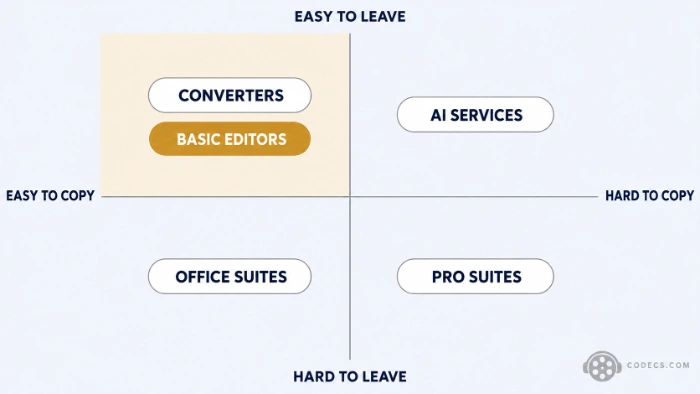
The safest are the opposite: big suites people stay with because of their files, plug-ins, training and the people they work with. Office suites sit in between - easy to copy on the surface, hard to leave because everyone shares the same files.
Investors already see the difference. Shares of subscription software companies fell by about a quarter in the first three months of 2026, a slide traders nicknamed the SaaSpocalypse.
Adobe's weakest point is trust, not code. In March it agreed to a $150 million settlement of a US government lawsuit over its subscription and cancellation practices, while denying wrongdoing, and projects like ArtCraft are as much a reaction to that frustration as a product.
Why Free Alternatives Still Lose
GIMP has been free for nearly 30 years and still has not replaced Photoshop at work. The reasons have little to do with features:
- Files. A client sends a PSD and expects one back that opens exactly the same.
- Habit. Years of shortcuts, tutorials and courses are built around Adobe's layout.
- Plug-ins. Many workflows depend on add-ons that only run inside the original.
- Other people. Studios, schools and print shops agree on one tool, so one person switching changes little.
The Craft apps go straight at the habit problem by copying Adobe's menus and shortcuts, something GIMP never tried. A familiar menu makes switching feel easy, but your files still have to come out right, and that is the part still missing.
A Thousand Copies: Which Download Do You Trust?
When copying software gets cheap, so does copying download pages. Within a week of launch, an unofficial third-party download page for the ArtCraft apps had already appeared.
It may be perfectly honest. But it shows how quickly copies of copies arrive, and fake download pages are one of the oldest ways to spread malware.
Open-source projects feel the strain too. QEMU, a volunteer-run project, received 132 AI-generated bug reports in a single day, and Google froze part of its bug bounty after a flood of junk AI reports.
Before you install any new app, AI-built or not, check these five things:
- Official source. Download from the project's own page or a site that points to its official builds, never from a link in an ad or a comment.
- Matching version. The version number and publisher should match the project's own release notes.
- A real track record. Look for regular releases, answered bug reports and more than one person behind the project.
- No paid copies of free apps. Nobody needs to sell you a pro or unlocked version of free software - that is a classic trap.
- Your work on copies. Test new apps on duplicates of your files until you trust them.
This is also why download directories like ours exist. We list where each app comes from, track its versions and point you to the official project, so you can see what you are getting before you click.
So, Is Software Over?
No. What is ending is the idea that writing a first version is the hard part. When anyone with AI can build a convincing copy, what people pay for moves to the things that are hard to copy: reliability, compatibility, support and trust.
For you, that probably means more free apps that look familiar, more pressure on subscription prices, and more reason to be careful about where you download things.
| If you... | What to do now |
|---|---|
| Edit photos now and then | Try PhotoCraft or Affinity, both free |
| Swap PSD files with clients | Keep Photoshop and test the copies on duplicates |
| Edit video as a hobby | DaVinci Resolve is free and mature today |
| Rely on plug-ins or a team | Stay put and check back in six months |
Quick questions
Are the AI-built Adobe copies legal?
No court has ruled on these apps yet. US courts decided in the 1990s that copying a program's menu layout is not copyright infringement on its own, but copying its code, icons or artwork would be.
Are they safe to install?
The code is public and the apps run on your own computer. Get them from the official project page or a trusted directory, and keep backups, because early versions can crash or save files differently.
Should I cancel my Adobe subscription?
Not because of these apps alone. Try a free tool on your real work first, and check your plan's cancellation terms before you switch, because annual plans can carry an early cancellation fee.
Can AI now copy any app?
It can build a convincing first version of many apps very quickly. Matching every feature, file format and plug-in still takes far longer, as ArtCraft's own estimates show.
Who made ArtCraft?
Developer Brandon Thomas, working with AI coding agents. The apps are open source under the MIT or Apache licence, so anyone can read, change or reuse the code.
The bottom line
AI can now copy the outside of an app in days, but the files, the fixes and the trust still take time. Would you switch? Tell us what would make you leave your current editor.


Latest reviews
AllJPEG XL Is Back in Chrome: What It Means and How to Open JXL...
5/5Brave just enabled it by default for stable users yesterday (1.97). Not specified is chromeOS will be passively gaining decode ...
The New Fire TV Stick 4K Can't Run Kodi - Here's Which Fire ...
5/5Really interesting news - I had no idea Amazon was switching the new Fire TV Stick 4K over to ...
Free Popular IPTV Playlist: Where to Get Fresh, Legal M3U Li...
5/5Hi! Thanks for creating this list, and I have a small question: why do the channels I used to ...