Rufus can build a Windows 11 USB stick that ignores the TPM 2.0, Secure Boot and memory checks, so a PC Microsoft calls too old will install it anyway.
What Rufus actually changes
Rufus writes the Windows 11 installer to your stick and switches off the checks that would stop setup halfway.
There is nothing to fix afterwards - no registry keys, no hidden command prompt, no patched install file.
It is one checkbox, not three.
Older tutorials describe three separate boxes for RAM, Secure Boot and TPM. Rufus combines all three into a single option, so if you are hunting for the other two you will not find them.
What you need before you start
- A USB stick of 8GB or more, with nothing on it you want to keep.
- Rufus, which runs straight from the downloaded file and needs no installation.
- A Windows 11 ISO from Microsoft's own download page.
- Ideally 4GB of memory and 64GB of free space - the bypass makes both optional, but below that Windows 11 is painful to live with.
Back up first. A clean install wipes the drive, and the honest time to think about that is before you make the stick rather than after - a full system image takes an hour and undoes any mistake.
Making the USB stick
- Open Rufus. The portable build runs from the file you downloaded, so there is nothing to install.
- Pick your stick under Device. Everything on it will be erased, so check you have the right one.
- Click SELECT and choose your Windows 11 ISO. Rufus recognises it and fills in the rest of the settings for you.
- Leave those settings alone and click START. A Windows User Experience box opens on top.
- Tick the box that reads 'Remove requirement for 4GB+ RAM, Secure Boot and TPM 2.0'. That single line is the whole bypass.
- Click OK and wait. Writing the stick takes about five to ten minutes on a normal USB 3 drive.
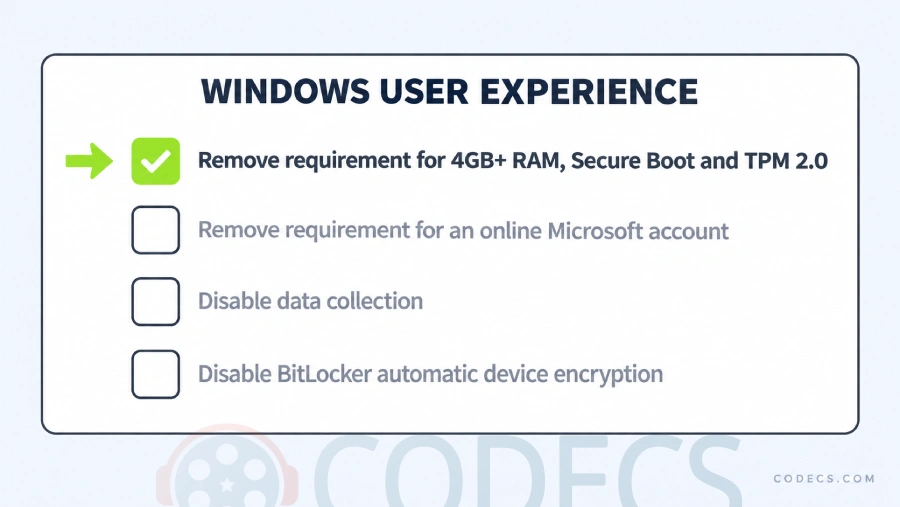
The same box carries a few other options worth a glance while you are there. You can have Rufus create a local account so Windows never asks you to sign in, skip the privacy questions, and turn off the automatic drive encryption that otherwise switches itself on quietly.
Read what is already ticked before you click OK. Rufus remembers choices between runs, and a version or two has shipped with the first option pre-ticked by accident.
Installing from the stick
Restart the PC and open its boot menu - usually F12, F2, Esc or Del, tapped as the logo appears. Choose the USB drive from the list and let setup start.
From there it is an ordinary Windows 11 installation. The screen that would have told you your PC is not supported simply never appears.
If you would rather keep your files and programs, do not boot from the stick at all. Open it in File Explorer from inside your current Windows and run setup.exe, which performs an in-place upgrade with the same checks removed.
The one thing no tool can remove
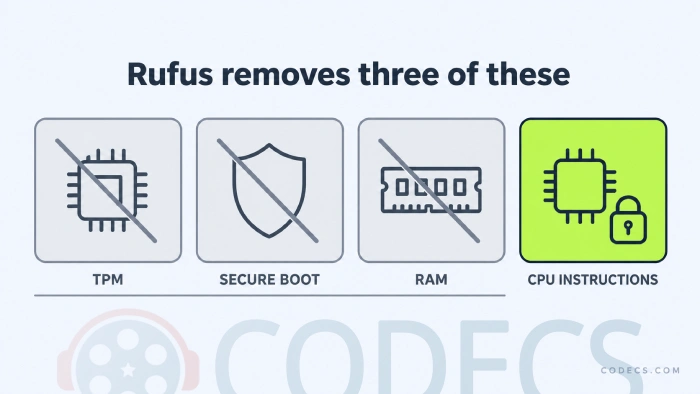
Recent Windows 11 releases need two processor instructions called POPCNT and SSE4.2, and that requirement is baked into the operating system rather than into the installer. No checkbox reaches it, and neither does any rival tool.
Roughly speaking, Intel chips from 2009 onwards and AMD chips from 2011 onwards have both. Anything older will either refuse to install or boot to a stop code, and there is no way around it short of new hardware.
Everything else on the requirements list is negotiable. The processor instruction floor is not, which is worth checking before you spend an evening on this.
What you give up
Microsoft's own wording is blunt: an unsupported PC 'will no longer be supported and won't be entitled to receive updates', and damage caused by the mismatch is not covered by the manufacturer's warranty. You have to accept that on screen during setup.
In practice, updates have kept arriving for most people running bypassed installations, including the yearly feature updates. Entitled is not the same word as blocked, and Microsoft has been careful to keep the difference.
You also get a small watermark in the corner of the desktop and a note in Settings, and you lose the security features that genuinely need a TPM. For a home machine that mostly browses, streams and prints, none of that changes the day to day.
If you would rather not make a USB stick at all
FlyOOBE does the same job without the drive. It fetches the ISO itself and runs the upgrade from inside your current Windows, which suits anyone who wants to keep their files and skip the boot menu entirely.
It also cleans up afterwards, and the FlyOOBE debloating guide covers that side of it. Note that the Windows 11 Installation Assistant is not an option here - it runs the requirement check itself and stops.
Still deciding whether any of this is a good idea on your particular machine? The case for and against upgrading unsupported hardware lays out both sides.
Quick questions
Does the Rufus bypass still work?
Yes, for the TPM, Secure Boot and memory checks. It has survived every Windows 11 release so far, and Rufus is actively maintained, so it tends to be updated within days when Microsoft changes something.
Why can I only see one checkbox instead of three?
Because Rufus merged them. The single line covering RAM, Secure Boot and TPM 2.0 does everything the three older options did.
Will my PC still get security updates?
Almost certainly, though Microsoft says you are not entitled to them. Monthly and feature updates have continued to reach bypassed installations, but it is a courtesy rather than a promise.
Do I need to change anything in the BIOS first?
No. Leave Secure Boot and TPM exactly as they are - the point of the bypass is that Windows stops asking. Never switch on legacy or CSM boot to make this work, because that creates a different problem.
Can I upgrade without wiping the drive?
Yes. Run setup.exe from the finished stick while your current Windows is running, and choose to keep your files and apps.
Do I need a product key?
Not to install. A Windows 10 key or digital licence still activates Windows 11, and the guide on getting Windows 11 for free legally covers what counts and what no longer does.


Latest comments
AllHola cuando descargo un video con mpc-hc lo descarga en formato webm en vez de mp4 o mp3
Team replied Guide: How to Stream Videos with MPC-HC 1 commentInteresting development with the Fire TV Stick 4K — losing Kodi sideloading is a big deal for a lot of users. For those ...
News: The New Fire TV Stick 4K Can't Run Kodi - Here's Which Fire Stick Still Can 3 commentsThanks genius, it worked for me. v2.4.149.0 on windows 10
Guide: How to Download HEVC Video Extension for Free 181 comments